America at 250: Jacksonville’s rise as a leading U.S. maritime gateway
  • Home
  • >
  • Cargo Blog
  • >
  • America at 250: Jacksonville’s rise as a leading U.S. maritime gateway

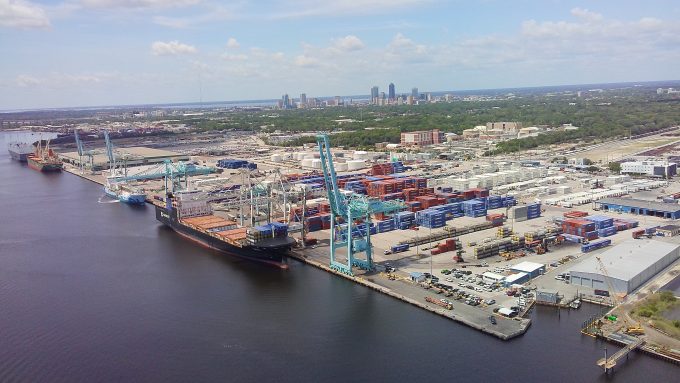
JAXPORT's Talleyrand Marine Terminal
Jul 2, 2026 | Cargo Blog
6 MIN READ

As America prepares to celebrate 250 years of independence, Jacksonville’s connection to the nation’s maritime history stretches back even further. More than two centuries before the United States was founded, Northeast Florida served as a natural gateway connecting people, commerce and cultures.

Jacksonville’s maritime roots extend to the 16th century, when French explorer Jean Ribault entered what is now the St. Johns River in 1562. Three years later, English traders exchanged goods with the French colony at Fort Caroline in what is recognized as the first documented act of international waterborne commerce in the New World, giving Jacksonville its distinction as America’s First Port.

Early encounters by European explorers highlighted the river’s importance as a natural harbor and set the stage for centuries of maritime commerce. The United States established Jacksonville as a port of entry in 1822. As Florida’s economy grew during the nineteenth century, the St. Johns River emerged as a vital commercial gateway for timber, cotton, pine products such as turpentine and tar, and other commodities. Steamships followed, railroads connected to the docks, and the military increasingly depended on Jacksonville’s strategic location.

But geography alone didn’t create today’s port. Jacksonville became a maritime powerhouse through generations of engineering, public investment and civic leadership that transformed the River City into one of America’s leading gateways for global trade.


Historical photo shows JAXPORT’s Talleyrand Marine Terminal in 1964

archive photo of the Talleyrand Marine Terminal in 1964

Maintaining a commercial shipping channel

The Mayport Jetties were constructed by the Army Corps beginning in 1881, a project that continued well into the twentieth century. Before construction, shallow sandbars and shifting shoals made the river entrance treacherous and prevented large vessels from entering safely. The Jetties are mile-long rock walls that line the mouth of the St. Johns River from the Atlantic Ocean, channeling river currents to maintain a navigable shipping channel.

According to the Jacksonville History Center, the mile-long rock walls permanently transformed Jacksonville’s maritime economy. Designed by famed engineer James Eads, the Jetties use the river’s natural current to keep the shipping channel clear, allowing vessels of all sizes to enter and leave the port.

Dr. Alan Bliss, CEO of the Jacksonville History Center, frequently highlights the Mayport Jetties as one of the most significant yet underappreciated engineering projects in Jacksonville’s history.

“Without the Jetties, Jacksonville would never have become a major seaport,” Bliss said. “It’s a big city because it became a major seaport, and that happened because of the Jetties.”

Improving navigation

Beginning in the 1880s, Jacksonville residents and business leaders raised money to dredge the St. Johns River and remove the massive sandbar at its mouth, allowing deep-draft international cargo ships to reach the city docks.

“What was unique about this is that it happened because 100 percent of local funds were raised here,” said Lindsey Brock, Past President of the Propeller Club – Port of Jacksonville and Shareholder at Fowler White Burnett’s Jacksonville office. “Local businesspeople realized that the river and the port were main catalysts for the growth and development of Jacksonville.”

The effort was spearheaded by the Jacksonville Board of Trade. Founded by local merchants in 1884, the organization was created specifically to advocate for the city’s commercial interests, which depended on improving river navigation. In 1895, the U.S. Army Corps of Engineers completed dredging from the Mayport Jetties to downtown Jacksonville.

Advocating for economic opportunity

Over the decades, the Jacksonville Board of Trade broadened its mission to represent the area’s entire business community. 

The first shipment of imported automobiles (seven Volkswagon Beetles) moved through Jacksonville's port.

The first shipment of imported automobiles (seven Volkswagon Beetles) moved through Jacksonville’s port (pictured is Talleyrand Marine Terminal) in 1957.

By the early 1960s, the organization had become the Jacksonville Chamber of Commerce, known today as JAX Chamber.

Eager to build port business and economic opportunity for the community, the Chamber and Senator Jack Mathews successfully urged the Florida Legislature to establish the Jacksonville Port Authority in 1963. 

The City transferred the Talleyrand Municipal Docks and Goat Island, later renamed Blount Island, to the new authority.

an old logo of JAXPORT

In 2001, the former Jacksonville Port Authority was divided into two independent agencies: the Jacksonville Airport Authority (JAA), which assumed responsibility for the region’s aviation facilities, and the Jacksonville Seaport Authority, which continues to operate under the name Jacksonville Port Authority, or JAXPORT.

According to its charter, JAXPORT operates, manages, and controls the publicly owned seaport and related facilities located within Duval County and other authorized areas.

Fulton Cut

Another transformative project was construction of Fulton Cut, which straightened one of the river’s most difficult navigation routes and paved the way for development of today’s Blount Island Marine Terminal.

archive image of Blount Island in 1964

Blount Island itself was created during the 1960s by the U.S. Army Corps of Engineers using dredged material excavated while constructing Fulton Cut and Dames Point Cut. Four smaller marsh islands were combined into a single landmass, providing an efficient location to place millions of cubic yards of sediment while creating valuable industrial property.


Blount Island in 1971 with some of the first buildings on the terminal

aerial photo of Blount Island in 1971
Blount Island in 1978


Blount Island in 1978, the terminal had already begun handling containers and vehicles

Continued dredging deepened the navigation channel, allowing increasingly larger vessels to reach Jacksonville more efficiently. 

Blount Island then to Now

From then (left in circa 1960s) to now (right in 2026), over time, improvements at Blount Island transformed it into a modern marine terminal capable of handling a diverse range of cargo while supporting future growth.

One of the first cranes on Blount Island - this was January 1972

One of the first cranes (left) stands on Blount Island in 1972. Today (right), Blount Island is home to 11 ship-to-shore container cranes. 

“When you look at the history of investments made in our port and our river, they have always resulted in more jobs and more economic growth for the City of Jacksonville,” Brock said. “It is encouraging to see those investments continuing today. From deepening the river channel to raising the power lines crossing the river, these investments will bring more ships and larger ships to the Port of Jacksonville, and that means more jobs for our citizens.”

The Jacksonville Port Authority acquired the final property for its third marine terminal, Dames Point (left), in 1998. The terminal today (right) moves a diverse mix of cargo (containers, auto, breakbulk, dry bulk) and provides year-round cruise service from Carnival Cruise Lines and seasonal cruise service from Norwegian Cruise Line.

Today, those generations of investment and foresight have made Jacksonville one of the nation’s leading logistics and distribution hubs. From its earliest days as a center of commerce in the New World, Jacksonville’s port has evolved into one of America’s busiest seaports through more than 170 years of strategic infrastructure improvements. 

As America celebrates 250 years of independence, Jacksonville’s maritime story reflects the ingenuity, determination and partnership that have shaped both our port and our nation. From its beginnings as America’s First Port to its role today as America’s Logistics Center, Jacksonville continues to connect Florida and the nation to the global marketplace while building on a maritime legacy more than four centuries in the making.

 
Take a look at more JAXPORT history below


A 50-ton crane stands at Blount Island in 1974


Blount Island in 1971 showing one crane and two warehouses


Automobiles move through the Talleyrand Marine Terminal in the 1970s


Talleyrand Marine Terminal in 1973