Planning Heavy Electrical and Project Cargo Through JAXPORT
- Home
- >
- Cargo Blog
- >
- Planning Heavy Electrical and Project Cargo Through JAXPORT
The backdrop: America is rebuilding its grid, and critical equipment is in short supply
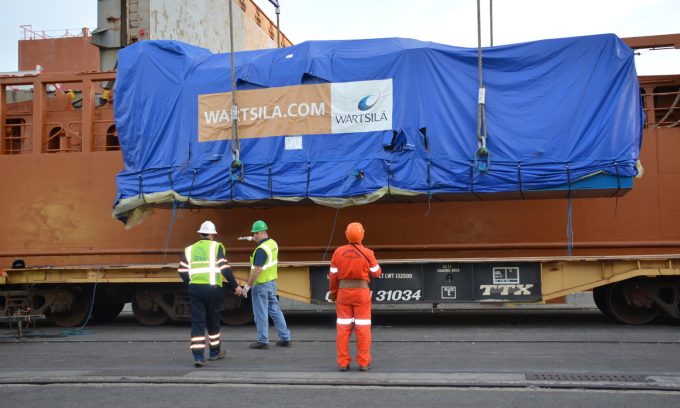
By Jeff Price, JAXPORT Marketing DirectorU.S. demand for large electrical equipment is rising, while the country remains heavily dependent on imports – particularly for large power transformers.
Research firm Wood Mackenzie estimates that U.S. demand for generator step-up transformers, which raise generator output to transmission voltage, increased 274% between 2019 and 2025. Demand for substation power transformers rose 116% over the same period.
New power generation, industrial expansion and reshoring, broader electrification, and replacement of aging grid equipment are all contributing to the pressure.
DOE identifies data centers and domestic manufacturing among the forces increasing electricity demand and straining grid-component supply chains.
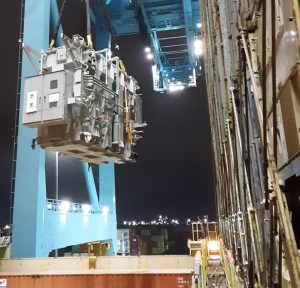
Imported equipment is increasingly the answer. The U.S. Department of Energy (DOE) estimates that imports supply about 82% of U.S. large power transformers.
But delivery requires long planning horizons.
Industry estimates put average lead times at roughly 128 weeks for power transformers and 144 weeks for generator step-up units, while some large custom units have been quoted at up to four years.
The scale of the data-center buildout illustrates the demand ahead. ConstructConnect valued U.S. data-center construction starts through June 2026 at $81.5 billion – already above the $72.5 billion recorded during all of 2025.
For supply-chain directors, that creates a sustained need to move transformers, generators and other oversized electrical equipment efficiently.
JAXPORT’s Blount Island heavy-lift berth offers load capacity of up to 2,000 pounds per square foot, on-dock rail and high-and-wide rail clearances.
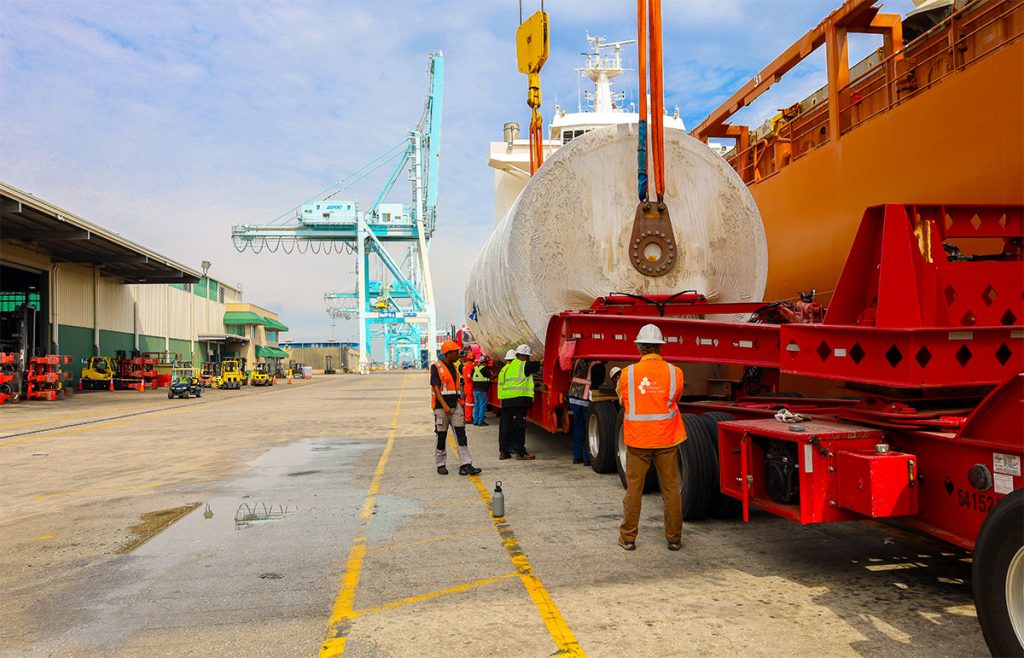
The port has demonstrated experience moving this equipment, such as a 331,000-pound generator.
Engaging the port, carrier, terminal operator or stevedore, and other responsible specialists early can help identify lifting, routing and equipment constraints before they impact an in-service date.
What often gets missed until it becomes a problem
Cargo data and lift planning, submitted early
Before a carrier, terminal or stevedore can finalize a heavy-lift operation, it needs accurate cargo information: verified piece weight, dimensions, center of gravity, lifting points and relevant drawings.
The responsible party can then develop the lift plan, including crane configuration, sling geometry, rigging loads and the sequence of operations. Who prepares and approves that plan depends on the carrier, terminal, stevedoring contract and insurance requirements. The UK P&I Club’s heavy-lift guidance emphasizes properly developing and documenting a lifting plan with accurate center-of-gravity and rigging information.
Providing this information only shortly before arrival can delay engineering approval, equipment selection or labor scheduling. Treat the cargo data package and any required lift plan as booking-stage deliverables, with responsibilities clearly assigned.
Marine warranty survey requirements
For some high-value or technically complex shipments, insurers or project lenders may make approval by an independent marine warranty surveyor a condition of coverage.
The surveyor’s scope may include reviewing lift, load-out, transportation and seafastening procedures and attending specified operations such as load-out, sail-away or discharge. The requirement is contractual rather than automatic for every out-of-gauge shipment.
Confirm the scope with the cargo underwriter or broker before operations begin, and include surveyor reviews, attendance and approval milestones in the shipping schedule. The DNV marine-operations and marine-warranty standard describes survey requirements relevant to load-out, voyages and installation or removal.
Lashing and seafastening engineering
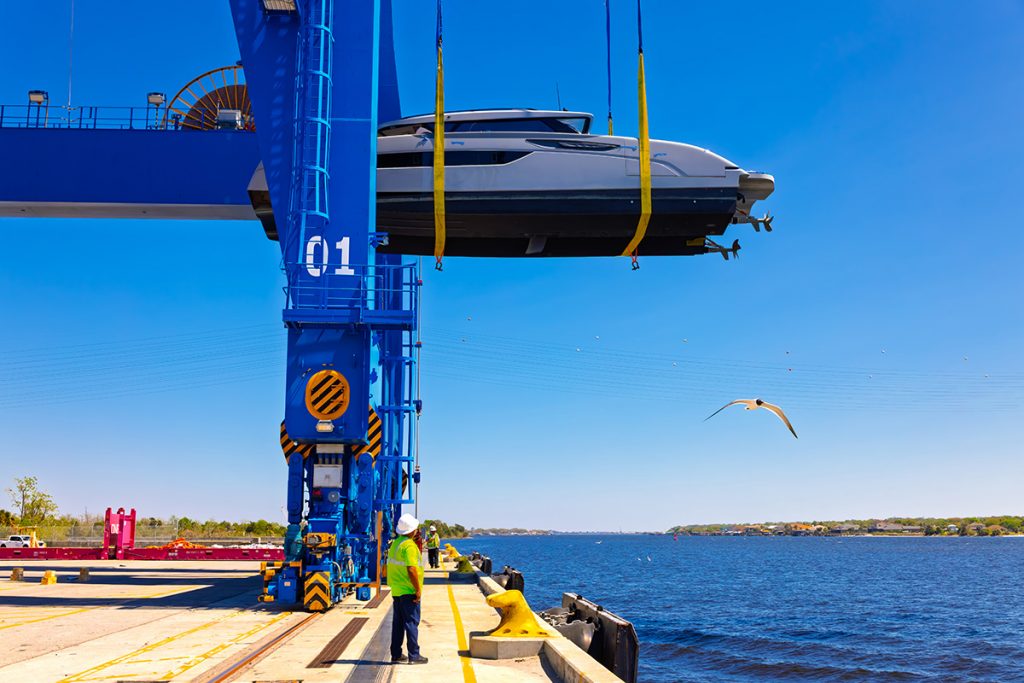
Heavy and irregular cargo must be stowed and secured in accordance with the vessel’s approved Cargo Securing Manual and applicable IMO guidance. The IMO’s cargo-securing guidance and Code of Safe Practice for Cargo Stowage and Securing emphasize proper planning, execution and supervision.
Depending on the cargo’s weight, height, footprint and center of gravity, the securing design may require vessel-specific calculations, grillage, welded stoppers or shoes, bracing and lashings.
Those arrangements must be coordinated with the vessel’s stowage plan, structural limits and stability calculations. Cargo drawings and design loads should therefore be available early enough for engineering review and fabrication before loading.
ISPM 15-compliant wood packaging
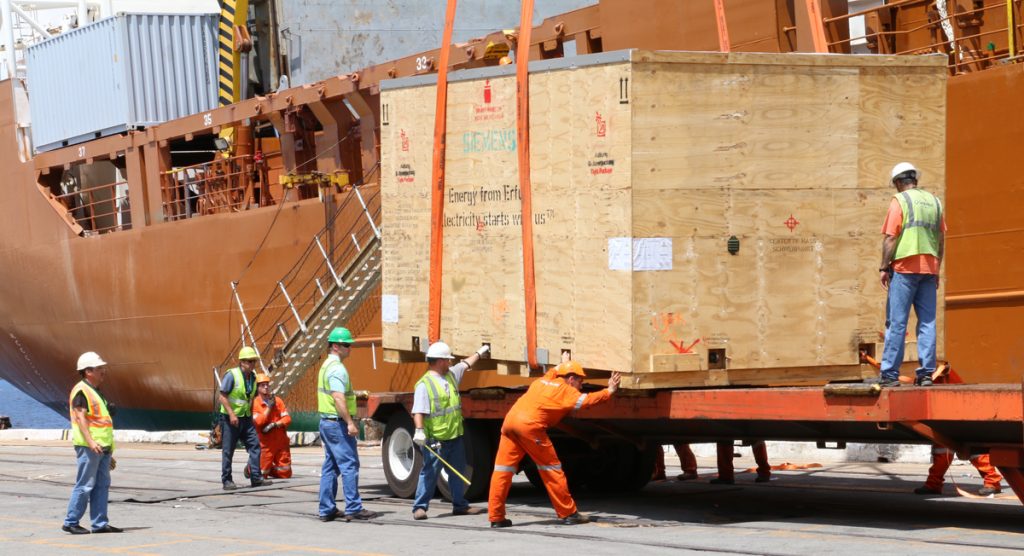
Regulated solid-wood crates, skids, blocking and dunnage used in international trade may need to be debarked, treated and marked under ISPM 15.
For cargo entering the United States, compliant material must bear the official IPPC mark; export requirements depend on the destination country and applicable exemptions. Noncompliant packaging can result in inspection, treatment, re-export or refusal of entry, so compliance should be addressed when packaging is designed and sourced.
See the USDA Animal and Plant Health Inspection Service requirements for imports and exports.
Consistent classification and customs documentation
Industrial projects may include components that fall under different tariff classifications.
Under the Harmonized Tariff Schedule of the U.S., exports generally use Schedule B or an eligible corresponding HS code, while the destination country applies its own tariff schedule.
The commercial invoice should contain the customs description, classification and value. The packing list should identify each package and its contents, marks, net and gross weights and dimensions, and its information should agree with the commercial invoice and bill of lading.
Classification or documentation errors can lead to additional duties, examinations, penalties or clearance delays.
The International Trade Administration explains the distinct purposes of the commercial invoice, packing list and bill of lading, and CBP lists the information required on a commercial invoice for U.S. entry.
Inland permitting lead time
Cargo leaving the terminal by heavy-haul truck may require Florida oversize or overweight permits, a defined route, clearance verification, escorts and restricted travel windows.
Local roads and structures may require additional authorization. This process should run alongside ocean planning rather than wait for the vessel’s arrival. See the FDOT Over-Weight Over-Dimension Permit Office.
Booking and cargo-ready dates
Heavy-lift capacity may be offered through scheduled liner services, flexible semi-liner rotations or tramp and charter employment.
On flexible services, port calls and timing can depend on vessel position, cargo commitments and route economics; even liner services may have inducement calls or limited space for unusually heavy pieces, such as multipurpose carriers Spliethoff and BBC Chartering. Secure capacity early, understand whether the quoted sailing is fixed or conditional, and provide a cargo-ready window the carrier can rely on.
Get ahead of requirements with our 7-Point Project Cargo Planning Checklist.
Making the checklist executable
JAXPORT features a mix of dedicated breakbulk services, multipurpose operators and RoRo carriers serving different cargo profiles and trade lanes.
The port also accepts charter calls, so the published schedule is a starting point. Service availability, port calls, terminals and vessel capabilities should be confirmed for each shipment.
Breakbulk and multipurpose services at JAXPORT
The carrier-to-service assignments are listed on JAXPORT’s breakbulk-service roster:
- G2 Ocean serves the Americas via JAXPORT. Its open-hatch and multipurpose fleet carries forest products, breakbulk and project cargo.
- Saga Welco provides East Coast South America service using open-hatch gantry-crane vessels designed for forest products, breakbulk, project and bulk cargo.
- Spliethoff’s service connects JAXPORT with North Europe on a dedicated route, primarily handling paper and forest products, as well as containerized shipments.
- Wagenborg is another breakbulk carrier calling JAXPORT, operating general-cargo and project-capable vessels across the Baltic and North American markets.
- Schuyler Line Navigation Company operates Caribbean services which accommodate container, breakbulk and project cargo. The line’s U.S.-flag services offer flexibility in handling government and other preference cargo.
Other breakbulk carriers at JAXPORT have included Pan Ocean, Oldendorff Carriers, Meriso Shipping and U.S. Ocean.
RoRo services for vehicles, high-and-heavy equipment and static breakbulk
Pure car and truck carrier vessels are not limited to automobiles. Their ramps, adjustable decks and cargo-handling equipment can accommodate self-propelled and towable machinery as well as static cargo placed on roll trailers. At JAXPORT, this category includes equipment such as tractors, construction machinery, generators, buses and boats.
Available routes appear on JAXPORT’s current RoRo-service roster, but lines also offer inducement calls regularly.
- Höegh Autoliners has its North American HQ located in Jacksonville, and the line offers global cargo services.
- MOL Auto Carrier Express, or MOL ACE, operates routes connecting Jacksonville with Asia and the Americas.
- NYK Group Americas operates worldwide as well.
- Grimaldi Group connects Jacksonville with Africa, the Middle East, Mediterranean and Americas.
- Liberty Global Logistics links JAXPORT with the Middle East.
- Nissan Motor Car Carriers calls between JAXPORT and Japan.
- K Line operates throughout the Americas via JAXPORT.
In addition to global RoRo lines, the carriers serving the Jacksonville-Puerto Rico trade also support out-of-gauge and breakbulk cargo shipments. Crowley’s enclosed RoRo decks, Trailer Bridge’s barge deck space, and TOTE’s crane-loaded flat racks ensure static and rolling units move efficiently within vessel ramp, deck-load and clearance limits, respectively.
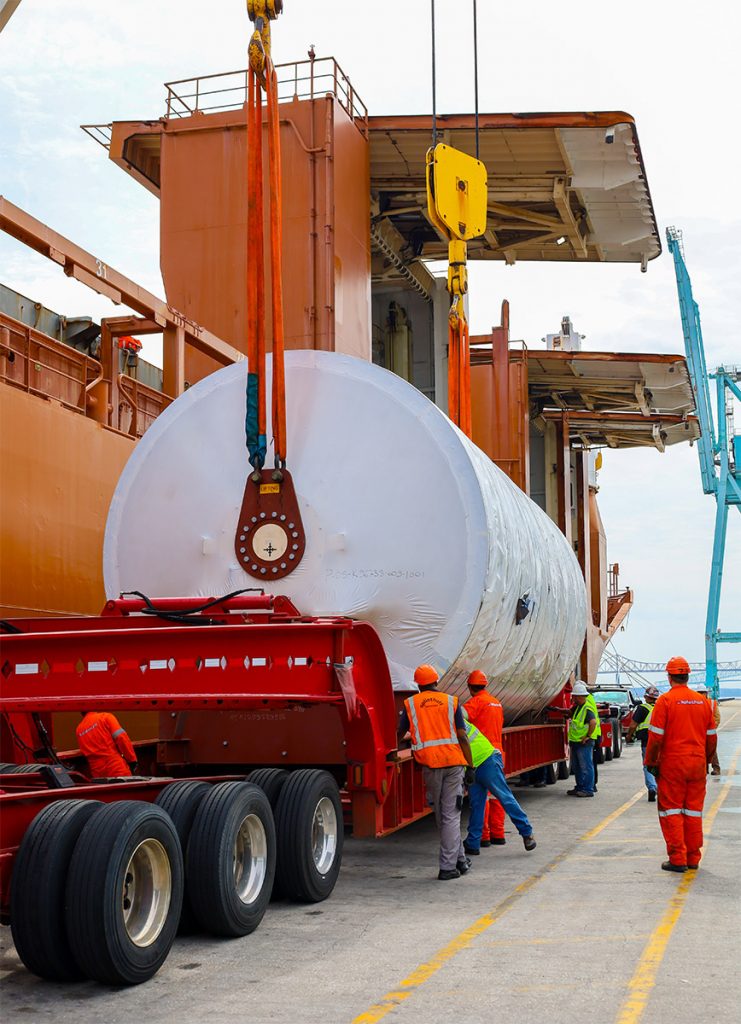
Matching cargo to the vessel, service and terminal matters as much as matching it to a berth. Self-propelled equipment can often move efficiently by RoRo, while generators, transformers and other static units may also qualify if they can be secured to a roll trailer and remain within the vessel’s ramp, door, deck-load and height limits.
Höegh has documented both a 112-metric-ton transformer shipment and its broader static-breakbulk capabilities.
Cargo exceeding RoRo limits – or requiring a direct crane lift – may be better suited to a geared multipurpose vessel and an appropriately rated berth.
The correct solution depends on more than whether the cargo has wheels. Weight distribution, center of gravity, lifting and lashing points, ramp capacity, deck clearance, vessel position, terminal assignment and inland routing should all be reviewed before the booking is finalized.
Put the checklist to work
Supply-chain directors evaluating JAXPORT for an upcoming project should coordinate vessel space and cargo acceptance with the ocean carrier while the other critical workstreams are still being planned.
The carrier and its assigned terminal operator or stevedore should receive accurate cargo drawings and weight, dimensional, center-of-gravity, lifting and lashing information early enough to evaluate the vessel, berth, equipment, stowage and handling plan.
JAXPORT offers world-class, experienced terminal operators and stevedores handling breakbulk, high and heavy RoRo and project cargo – including Enstructure, SSA Marine, AMPORTS, First Coast Terminals and APS Stevedoring.
Other requirements belong with different specialists. Confirm any marine warranty survey with the cargo insurer or broker; address ISPM 15 with the export packer, freight forwarder and customs broker; and begin route analysis and permitting with the heavy-haul carrier.
Bringing those parties into the process alongside the ocean booking gives the team time to resolve conflicts among vessel timing, terminal handling, survey approvals, packaging and inland delivery before they affect the cargo-ready or in-service date.
Carrier services, terminal assignments and vessel capabilities can change, so confirm the current arrangement with the carrier and JAXPORT’s cargo team for each shipment.
Start with JAXPORT – begin by contacting Director of Business Development Alberto Cabrera at +1 (904) 357-3094 or alberto.cabrera@jaxport.com.
Attending Breakbulk Americas in Houston, Texas? Stop by the JAXPORT exhibit at B07 during the event Sept. 22–23, 2026 and let’s plan your next shipment.